WHY is Calmness so important for our dogs? Calm is not a behavior, it’s an arousal state.
Dogs pick behaviors based on their level of excitement and in a nutshell, when dogs have a calm mind, they pick appropriate behaviors!
Below is an adaptation of James Russell’s Circumplex model where the horizontal axis represents valence and the vertical axis represents arousal. Valence refers to the positive and negative degree of emotion and arousal refers to the intensity of emotion. My graphic shows examples of behaviors that dogs choose, depending on their state of valence and arousal.
As you can see, ideal behaviors are always chosen when dogs are in the lower right quadrant (low arousal + positive emotion).

Calmness is a concept that we talk a lot about in my dog training. Lack of calmness is linked to most if not all behavior struggles and when we can increase calmness in our dog’s daily lives, those behavior struggles are often reduced or eliminated.
It’s a very common misconception that more exercise is the way to achieve a calm household or solve problem behaviors (like chewing, biting, jumping up, pulling on leash…). In reality dogs need to practice Calm in order to BE calm. This doesn’t mean that you shouldn’t exercise your dog, as long as you don’t do it with the purpose or expectation of achieving calmness in the long term.
What happens through repetitive and excessive ball (or frisbee) throwing is that dogs get in the habit of living in a state of high arousal. We may get periods of “calm” when they are tired out, but as soon as your dog has had some time to rest, they will crave getting back to that state of high arousal because this is highly addictive and therefore not a healthy life style.
Question: In your home, do you want your dogs to wear pajamas or disco pants?
Let’s get a little bit more scientific:
High arousal activities increase dopamine levels which make an individual feel good. When you do something that feels good, the brain releases a rush of dopamine. Dogs (and humans) naturally seek more of that good feeling by repeating the behavior that made them feel good. For dogs this could be something like fetching the ball or chasing a squirrel, or for humans, activities like eating, alcohol, gambling or binge-watching your favorite TV show. In excess, this can lead to more harmful behaviors like drug or alcohol abuse. For dogs it can lead to the inability to settle without being completely physically exhausted, or even behavior problems like abnormal repetitive behaviors (like light chasing), self-mutilation or other.
Instead, we want to increase activities that release serotonin, which is a neurotransmitter that, like dopamine, regulates mood and other bodily functions. Serotonin is connected to happiness and mellow moods, while dopamine is associated with feelings of elation.
*** Think of it like this: Dopamine relates to the adrenaline junkie, the gambler, the addict, while Serotonin is more mellow and serene, like a hippie!
Now that we understand that calmness is a healthier life style let’s look at some
Strategies to grow Calmness
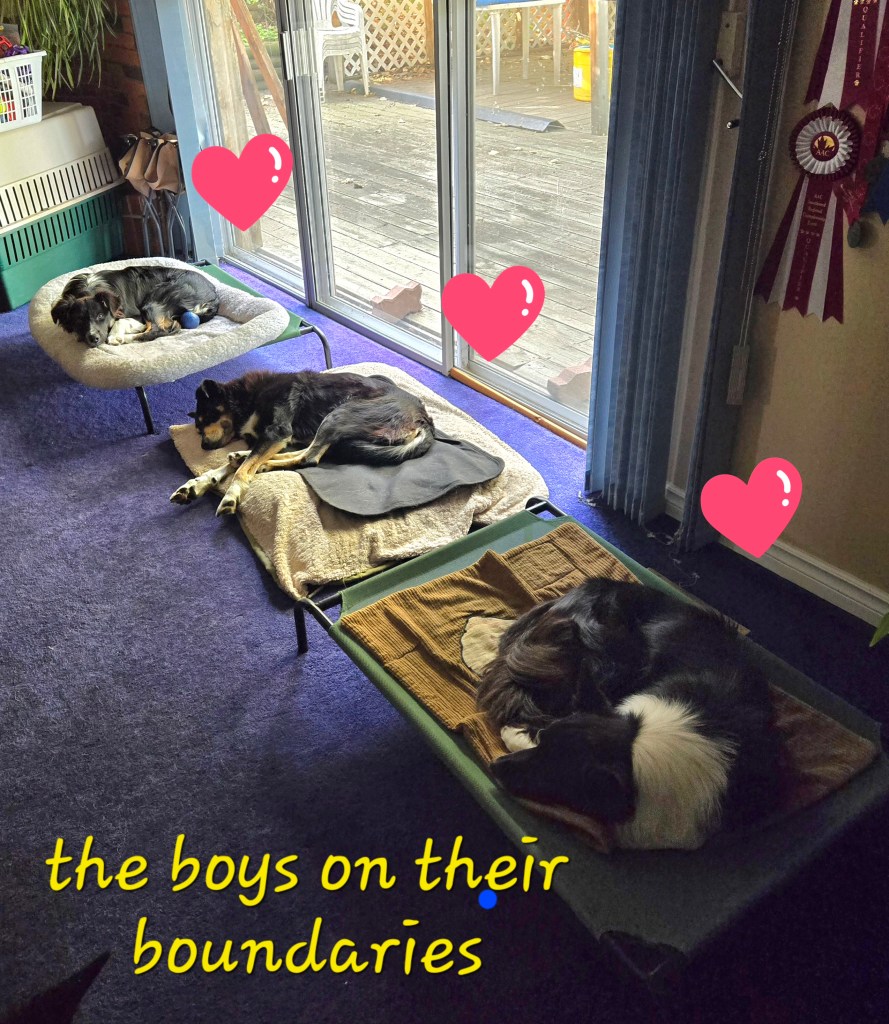
- Boundary Games, aka stationing, mat training … the purpose of Boundary Games is to grow value for something like a dog bed where the dog will learn to settle. By doing this, dogs are practicing a calm state of mind and therefore increase Calmness in their lives!
In this video, Davy was introduced to boundary games at the tender age of 8 1/2 weeks. As I’m writing this blog Davy is just over 8 months old and I’m really pleased with his ability to remain calm in most situations and not needing any high octane activities to achieve this “happy medium”.
This video shows some more advanced strategies for proofing and maintaining value for the boundary - Enrichment is using some or all of your dog’s daily food allowance in a way that gets more benefits than serving it in a bowl. We can grow calmness by using strategies like stuffed kongs or (hollowed out) marrow bones, scatter feeding, lick mats, snuffle mats, food puzzles, etc. To have an impact, I recommend using these strategies every day and strategically when you need calm, like when visitors come to your house or when it’s time for a nap in the kennel.
- Rehearsal: just like us humans, dogs are creatures of habit. What they do every day, will be repeated the following day, unless we change something. Developing new habits takes time, determination and patience but if you’re willing to make some changes for a few weeks, the results will be worth it! After each dopamine high, there’s a drop, which doesn’t feel good so the individual will be looking to get back to that “high” by repeating the action that produced that “good feeling”… this is what drives a gambler, an addict or ball obsessed dog!

It is my hope this blog has been helpful in explaining some of the “why”, “what” and “how” when it comes to Calmness. If you’re interested in learning more practical strategies, aka Games, and expanding your understanding and knowledge, please check out my CALM DOG class, either online or in-person.

 Pawsome Connection Dog Training & Behavior